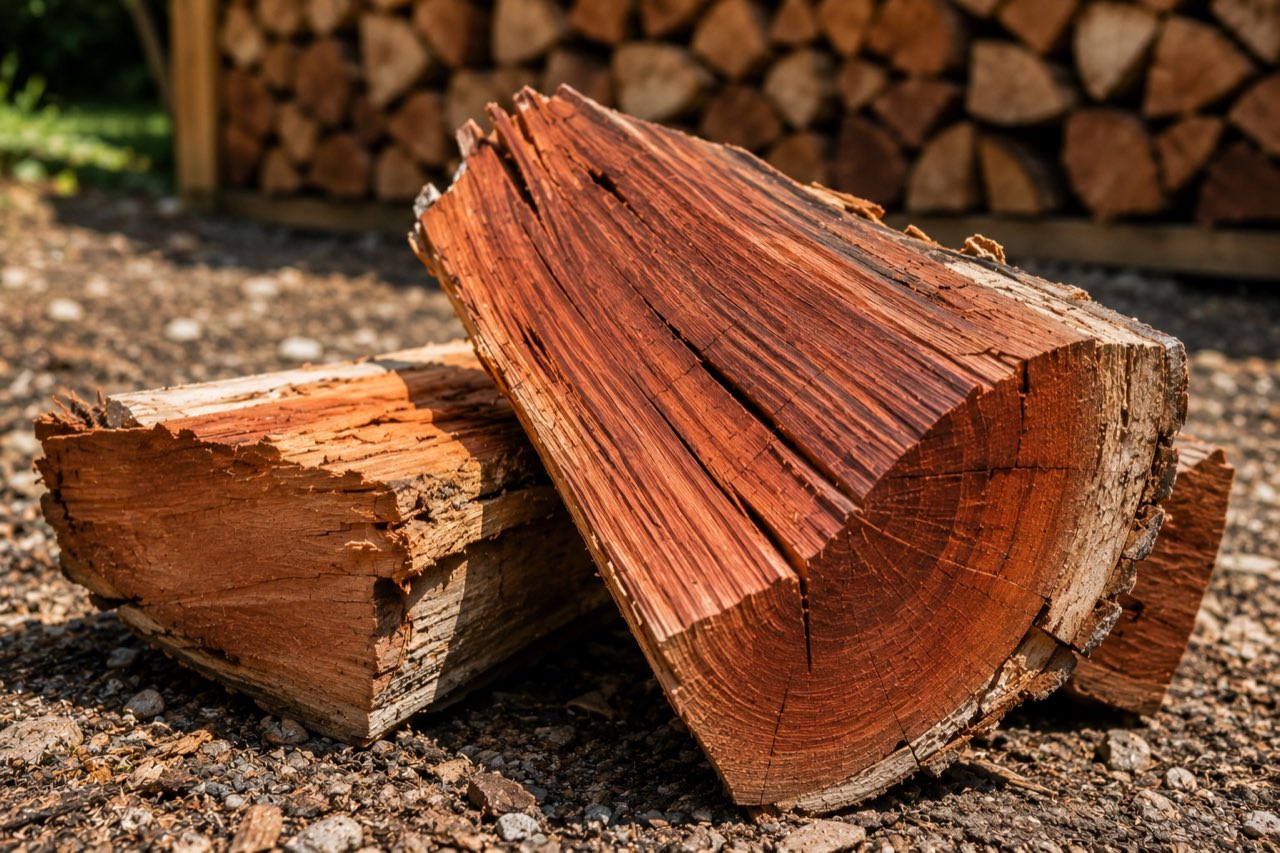
Seasoning is the difference between a fire that roars and one that hisses. Here's what it means and why it matters.
"Seasoned" simply means the wood has been dried until its moisture content is low enough to burn well — generally under about 20% moisture. It's the single biggest factor in how a fire performs.
Freshly cut firewood can be 40–50% water by weight. Burn it, and much of your fire's energy is spent boiling that water off instead of heating the room. The result is a fire that's hard to light, smokes heavily, hisses, blackens the glass and leaves creosote building up in your flue.
The number that matters is moisture content — the share of the wood's weight that is still water. Freshly felled hardwood can sit at 40–50%. As the wood seasons that figure falls, and once it's under about 20% it's generally considered ready to burn: it lights without a fight, burns hot, and produces far less smoke and creosote. The only way to know for certain is a moisture meter — split a piece, press the pins into the freshly exposed face, and read the number. Anything in the low teens is excellent; anything in the mid-20s or higher needs more time in the stack.
You can get a long way without a meter. Seasoned wood is noticeably lighter than a green piece of the same size, because the water has left it. Look at the ends: properly dried wood develops cracks — "checks" — radiating out from the centre as the fibres shrink. The bark on a seasoned piece is usually loose or has fallen away altogether, and the timber itself looks duller and greyer than fresh-cut wood.
Then use your ears and nose. Knock two pieces together: dry wood answers with a sharp "clack", while green wood gives a dull, heavy thud. Green timber also still smells faintly of sap and fresh sawdust, where seasoned wood smells of almost nothing. If a load arrives feeling heavy, looking bright at the ends and thudding when knocked, it isn't ready to burn — no matter what it was sold as.
Dense hardwoods dry slowly, and red gum is one of the densest. Split and stacked in the open air — off the ground, covered on top but open at the sides so the wind can move through — red gum generally needs a year or more to come down to burning moisture, and large unsplit rounds take considerably longer. That's why genuinely seasoned red gum is worth paying for: the waiting has already been done for you, in someone else's yard, over at least one full summer.
If you ever buy green wood intending to season it yourself, order it the winter before you need it, split it small, and stack it where it gets sun and wind — not in a closed shed or garage, where the moisture has nowhere to go.
Every load of our red gum is seasoned before it reaches you, so it's ready to burn on delivery — no waiting, no guesswork. Order or ask us anything →
Delivered and stacked across inner Melbourne — $499 per cubic metre.